I was moving constantly, but getting nowhere.
It seemed like this was the life I was destined to live — escaping my problems by indulging in sugar, nicotine and entertainment, only for them to pile up to a point that could no longer be ignored. Then I'd commit to a big change, go strong on days one and two, and on day three find myself in bed at 2am with a Pringles can and my computer on my chest.
I felt hopeless. I was treading water — spending all of my energy just to stay afloat.
After years of failing to change, I was losing hope I ever would.
In my early twenties I jumped head first into the unknown and started a company — I didn't know much about it, but I was determined to figure it out and learn as I went along.
Building a business gave me a purpose. Creating something myself that would help someone else, and living off of that, felt like the most meaningful thing I could do with my life.
But as the years went by, I still couldn't kick the bad habits. Even though I knew what I wanted, I still spent hours wasting time repeating the same old habits.
"The definition of insanity is doing the same thing over and over and expecting different results." — Einstein (allegedly)
By that definition I'd been insane for years.
My business was standing still, my mental health was gradually declining, and I'd trained for years with nothing to show for it.
I realized I had to do something different.
One day, sitting in my car, I made a commitment to myself.
I was going to dedicate my life to finding the answer to this one problem — why I couldn’t change.
At that point I defined it as "finding the key to transformation." It motivated me.
I didn’t just want this key, I needed it, desperately. If I didn’t change, my life wouldn’t — that was clear.
I gave myself ninety days to figure it out.
I'd build a system in Notion to track every area of my life — log it as it happened, then review the week every Sunday. I was going to use my body as a way to measure my progress, so I had physical proof of the transformation.
Every night I logged my day. When I fell into a bad habit I'd note what happened, what led up to it, what I could do differently. Then I'd reflect on my day and write it down. Every Sunday I reflected on what I wrote throughout the week. I looked for the patterns — I drew diagrams, reflected for hours and improved my systems. I thought that if my awareness of the problem grew, I would eventually find the solution to it.
But ninety days later I hadn't changed. My body had, but I hadn't. I was the exact same person, with abs. I still watched YouTube till late at night, ate terribly and numbed my mind with nicotine pouches. The only difference was that I'd showed up almost every day, for some type of exercise.
That was it.
It took me another four months to realize that was it — not exercise, but showing up. Consistency was the key I'd been looking for.
You might think, "well duh, everyone knows consistency is key." And I had heard it before too, but I'd never actually realized it before that day. It became obvious to me at that point that the problem I'd been dealing with all of this time was inconsistency. My problem wasn't bad sleep, sugar, lack of exercise or nicotine. The reason I never changed was because I was inconsistent — I didn't stick things out. I always quit before my actions could accumulate into results.
I started looking into consistency — how to create it.
And this, in short, is what I found:
To be consistently doing something you need to make it a habit. You can run on willpower for a little while, but if it doesn't become a habit you'll run out and revert back to your old ways.
To create a habit you put a clear cue in your environment, and practice doing the behavior you want that cue to trigger for long enough that it starts happening automatically.
Then you want that behavior coupled to your identity, so it becomes a natural expression of who you believe yourself to be. So the habit is supported by your psychological need to have coherence between your self-concept and your actions.
It was in looking into the mechanisms behind habit change that I saw something interesting.
You can't create a habit if you don't stick to the actions long enough for it to become one.
You need the capacity to stick things out — and that was the exact thing I'd been struggling with all along.
This made me realize that the many broken promises I'd made over the years had given me a self-belief of "I don't follow through" — and that belief was manifesting itself in my constant struggle to change my life.
I had created a habit of quitting when discomfort arose, and my identity was reinforcing that habit — a habit that made creating any other good habit impossible.
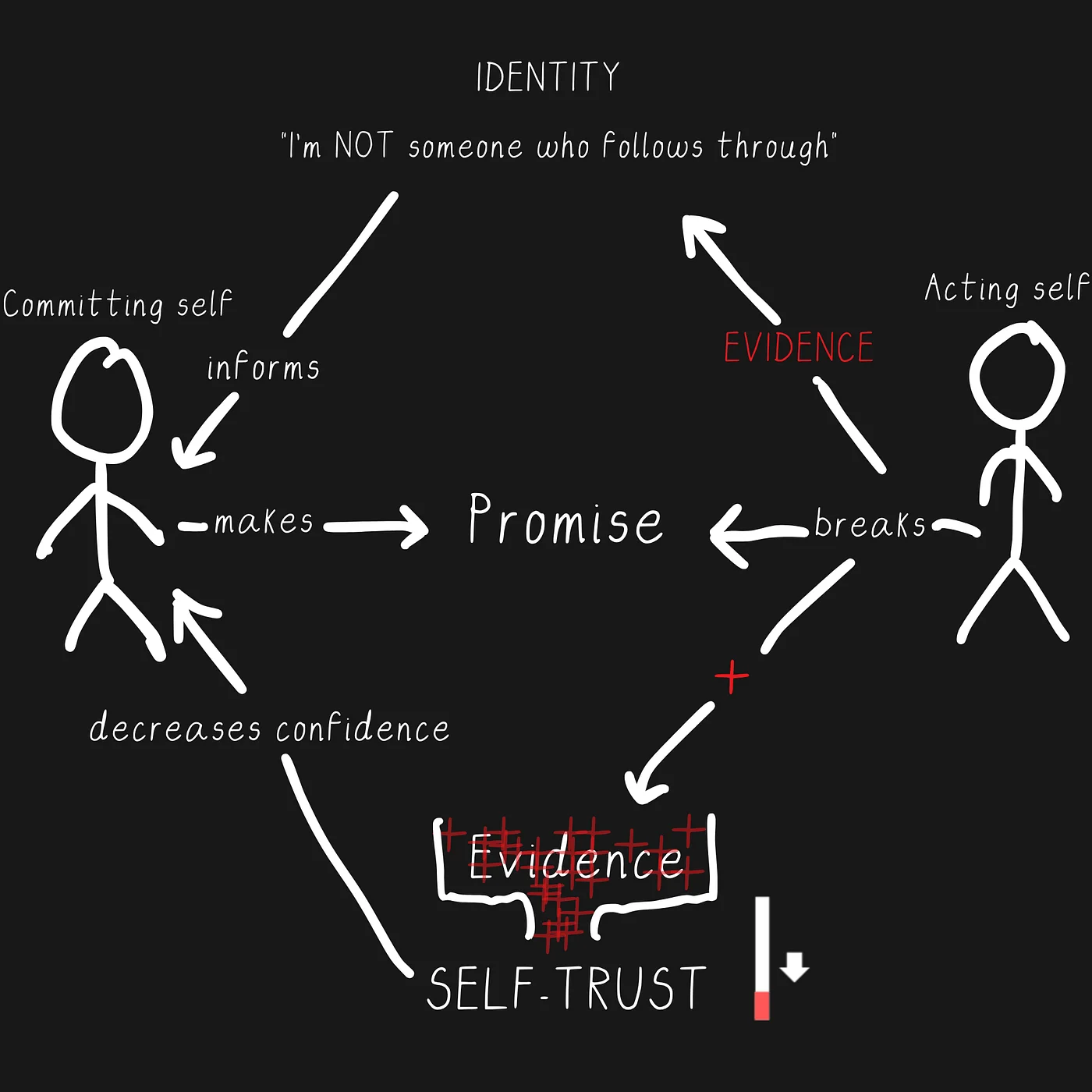
But if that was the case, the opposite would be true too. If I could somehow reverse this identity, it would make me automatically act instead of avoid, which would solve the root cause of my inability to change.
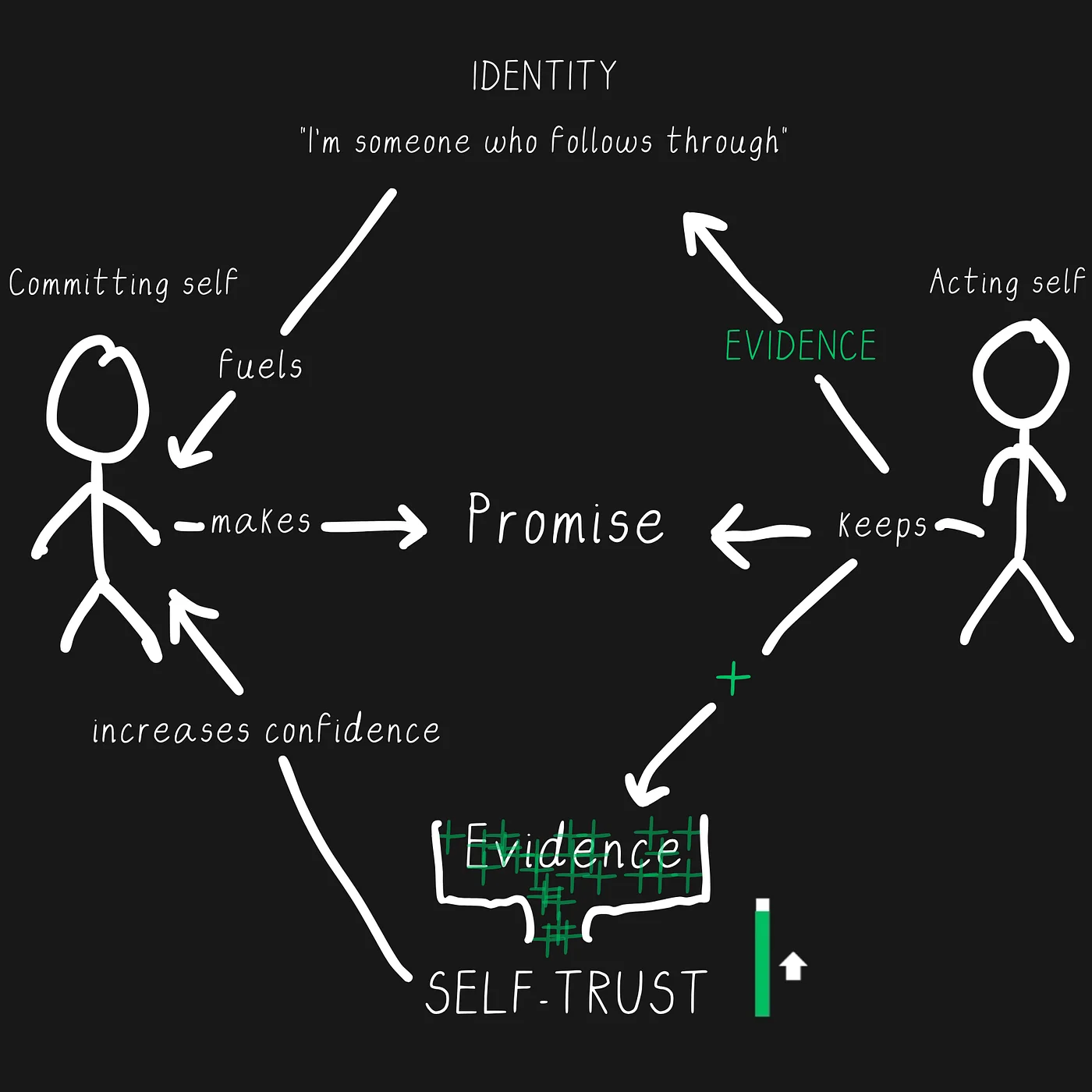
I thought, what if one could build an identity of a person who shows up consistently — then that identity would reinforce the habit of showing up consistently, which was the transformation I'd been looking for. It would be like a meta-habit — one that unlocks the capacity to build all other habits. The habit underneath all other habits. One that would allow someone to choose a direction and believe they'd actually get there.
What if I could design a system that would allow me to create enough evidence for my brain to start to accept the identity that I am someone who shows up whether they feel like it or not?
This sparked my idea for The Show Up Challenge.
The loop I'd been stuck in — making a bunch of promises to myself to change, failing to keep them, feeling shame, repeat — reliably produced the exact opposite evidence to what I needed.
If I were to believe I was someone who shows up whether they feel like it or not, I would have to keep the promises I made to myself.
And the answer was simple: stop making promises I couldn't keep, and only make one non-negotiable promise every day to build evidence of the identity.
With only one promise the evidence was clean. If kept, that's one piece of evidence for the identity. If not, that's evidence against it.
The one promise I chose was to show up for exercise, because it gives you relatively quick feedback, it's a habit so fundamental to all other areas of your life, and it's rewarding in itself.
Since the exercise was going to be the habit that would support the identity I was looking to build, I had to remove as much friction from showing up as possible.
In my previous ninety day challenge I had started to put my workout clothes out the night before, and it worked very well. Every morning I saw my workout clothes lying there almost as a message from my past self saying "here's the promise you've made, I've made it easy for you, put them on and show up."
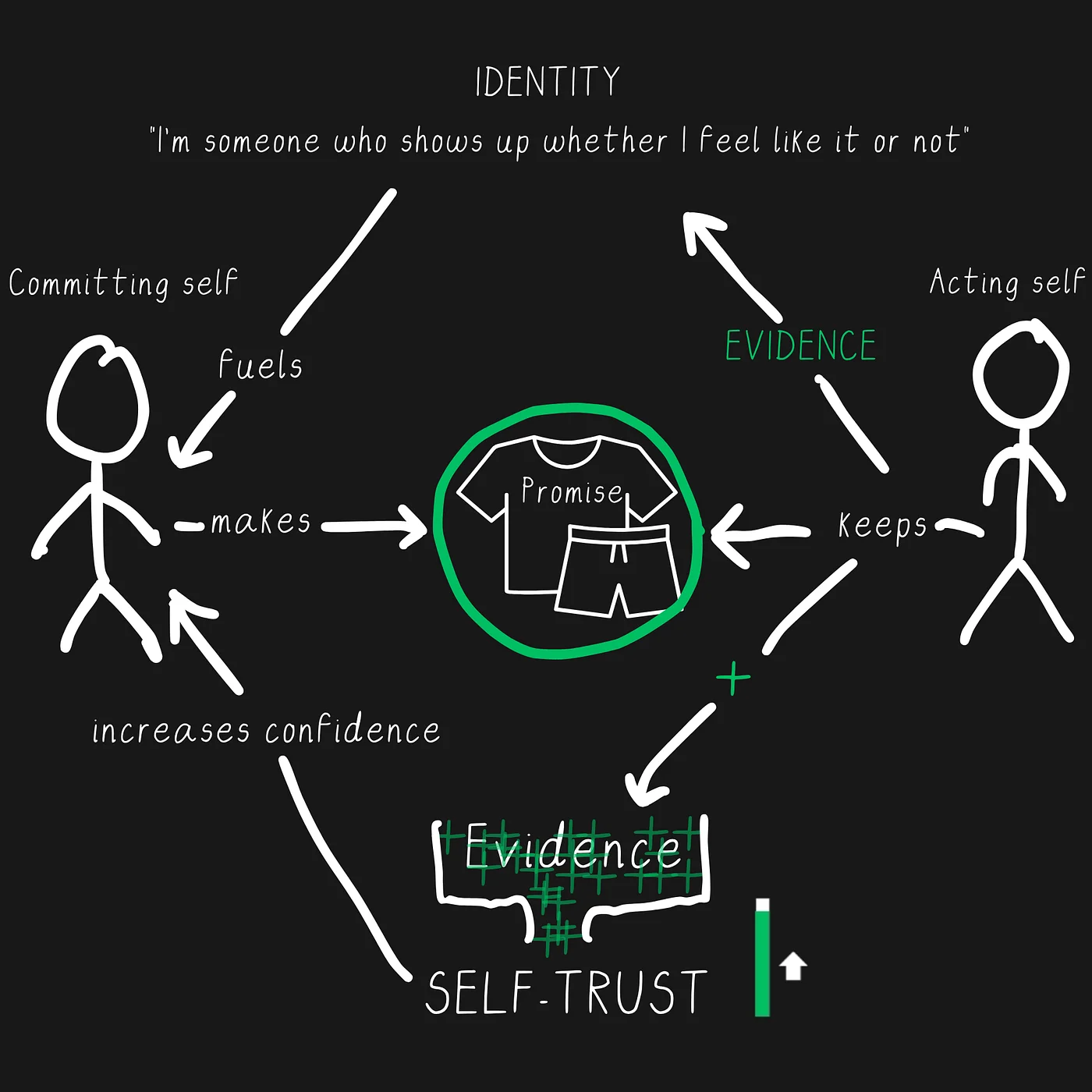
So I built that into the challenge as the one habit you actually focus on. Putting out your workout clothes is the most powerful habit to develop in order to show up consistently enough for the new identity to start taking root.
Another thing that had to be built in was a way to strengthen the signal of the evidence, so my brain would actually start to update its self-model. I created an evidence statement to say every day as I logged my day: I show up whether I feel like it or not.
The idea is that the exercise evidence, coupled with that statement, repeated over ninety days, starts making it feel like a truth about who you are.
My definition of the goal of the ninety day challenge came to be this:
To be able to say, without a hint of doubt in my body: I am someone who shows up whether I feel like it or not.
I've taken the challenge twice now, and I can say without a hint of doubt in my body: I am someone who shows up whether I feel like it or not.
Who I am today as a result is a completely different person than I was a couple of years ago. My baseline behavior is now exercising, getting to bed on time and working on my purpose. The pattern has flipped into the positive version. Before, eating sugar and going to bed late would have me go back to my self-destructive lifestyle. Now, eating sugar and going to bed late has me go back to my self-supportive lifestyle. If that is not what being transformed is, I don't know what is.
At this point I don't have to take the challenge anymore. I just use The Show Up System to track my workouts and progress — putting out my clothes in the evening, showing up in the morning and saying the evidence statement are just habits now.
Interestingly enough, this very website and everything on it would never have existed if I wasn't someone who shows up whether I feel like it or not. There have been a whole lot of obstacles and resistance that I've had to push through in order to create this. I would never have been able to share it if it hadn't worked for me, which has made it come full circle quite beautifully, I think.
If you want to take the free challenge click here → THE SHOW UP CHALLENGE